- About
- Programs
- Faculty of Graduate Studies and Research
- PhD in Business and Management Studies
- PhD in Information and Communication Technology
- Master of Science in Information Technology (MSc.IT)
- Master of Science in Cyber Security and Forensics
- Master of Science in Digital Finance and Technology
- Master of Science in Public Health (General)
- Master of Science in Public Health – Health Informatics
- Master of Science in Public Health – Epidemiology and Biostatistics
- Master of Business Administration (MBA)
- Faculty of ICT
- Master of Science in Information Technology (MSc.IT)
- Master of Science in Cyber Security and Forensics
- Bachelor of Science in Animation and Visual Effects (B.Sc. VFX)
- Bachelor of Science in Applied Information Technology (B.Sc. AIT)
- Bachelor of Science in Artificial Intelligence and Machine Learning (B.Sc. AI & ML)
- Bachelor of Science in Networking and Cyber Security (B.Sc. NCS)
- Bachelor of Science in Computer Science (B.Sc. CS)
- Faculty of Health Sciences
- Faculty of Business & Commerce
- Master of Science in Digital Finance and Technology
- Master of Business Administration (MBA)
- Bachelor of Business Administration in International Marketing (BBA-IM)
- Bachelor of Business Administration in International Business (BBA-IB)
- Bachelor of Hotel Management (BHM)
- Bachelor of Human Resource Management (BHRM)
- Bachelor of Science in Applied Economics (BSc-AE)
- B.Sc. Accounting and Finance
- Faculty of Engineering
- Diploma Programmes
- Pre-University / International Foundation
- Short Courses (Professional / Skill-based)
- Certified Cyber Security Specialist (CCSS)
- Certified Ethical Hacker (CEH) Certification
- Computer Hacking Forensic Investigator (CHFI) Certification
- ISBAT Certified Integrated IT Infrastructure Specialist Programme
- Data Science
- Python
- Cloud Computing
- Linux for Beginners
- Cyber Security for Beginners
- Certified Network Associate (CNA)
- PMP
- Faculty of Graduate Studies and Research
- ISBAT Online
- Research & Innovation
- Alumni
- Career
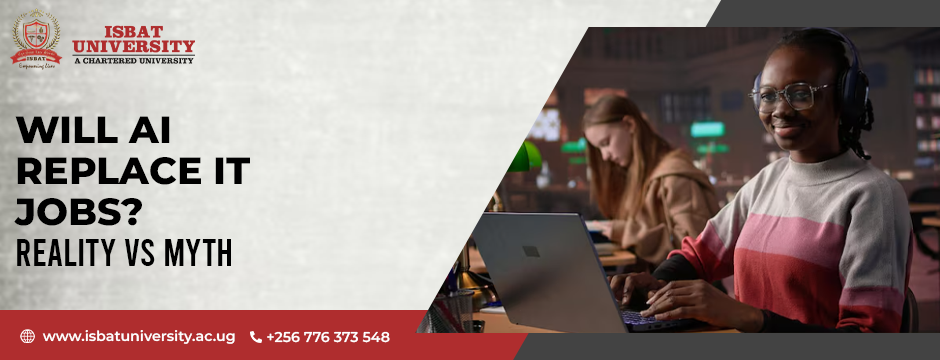
Will AI Replace IT Jobs? Reality vs Myth
February 23, 2026
Artificial Intelligence (AI) has rapidly shifted from science fiction to everyday reality, influencing industries, economies, and the job landscape. Among the sectors most affected by AI discussions is Information Technology (IT), an industry traditionally at the forefront of innovation. Headlines often proclaim that AI will replace millions of jobs, leaving fear and uncertainty in its wake. For IT professionals, whose work already involves automation, scripting, and machine learning, the question feels personal and urgent: Will AI really take over our jobs?
The answer isn’t a simple yes or no. Like any transformative technology, AI triggers both excitement and concern. It has the power to automate repetitive tasks, optimize complex processes, and even assist in coding. Yet, it also creates new opportunities that didn’t exist before. The reality is that AI is redefining work, not necessarily eliminating IT careers. It’s reshaping roles, enhancing productivity, and raising demand for skills that pair human ingenuity with algorithmic intelligence. Therefore, enrolling in an AI degree programs Uganda can help you to develop certain sets of skills that can boost your career growth. To understand this shift, we need to separate myth from reality and explore both what AI can and cannot do. For IT professionals, students, and educators alike, grasping this balance is vital for thriving in tomorrow’s digital workforce.
Reality: How AI Is Changing, Not Canceling, IT Jobs
AI Automates Tasks, Not Thinking
AI excels at automating routine, rule-based tasks. In IT, this includes tasks like server monitoring, basic bug fixes, and automated testing. Tools can scan code, detect errors, and even suggest improvements. However, AI does not replace creative problem-solving, critical thinking, or strategic planning, core aspects of IT work. Human expertise remains essential to interpret context, assess risks, and guide project direction.
For example, an AI tool might identify a vulnerability in code, but it takes a human engineer to understand the business implications, prioritize fixes, and communicate solutions to stakeholders. AI enhances efficiency, but it doesn’t replace the nuanced judgment humans bring.
AI Amplifies Productivity
Rather than eliminating jobs, AI functions as a productivity booster. Developers using AI-assisted coding tools can generate boilerplate code faster, allowing them to focus on complex architectural decisions. IT support teams use AI chatbots to handle common user requests, leaving advanced troubleshooting to skilled technicians. This shift allows professionals to tackle higher-value work, increasing both output and job satisfaction. Therefore, joining an AI degree programs Uganda can be advantageous for your future growth.
New Roles Emerge
With AI adoption comes demand for new types of roles:
- AI Trainers & Curators: professionals who guide machine learning models with human insight.
- Ethical AI Specialists: experts ensuring algorithms operate fairly and transparently.
- AI Integrators: engineers who embed AI solutions into existing IT infrastructure.
These are not replacements but expansions of the IT landscape. As AI evolves, so do career paths. Enrolling yourself in an AI certification Uganda from trusted institutions can bring potential results.
Myth: AI Will Replace All IT Jobs
Overestimating AI Capabilities
It’s a myth that AI understands contexts or possesses general intelligence. Today’s AI is mostly narrow AI, trained for specific tasks. It doesn’t “think” like humans, lacks emotional intelligence, and makes errors outside trained scenarios. An AI model can generate code snippets, but it cannot architect an entire software system with real-world constraints. This limitation keeps humans indispensable.
Job Loss vs Job Transformation
While certain tasks are automated, most IT jobs are transformed, not terminated. Roles evolve alongside AI capabilities, requiring professionals to learn new tools and paradigms. Historically, technology has disrupted labor markets, but it also created new opportunities. For instance, cloud computing once sparked fears of server technician obsolescence, yet today it fuels demand for cloud architects and security specialists.
Human Skills Still Reign Supreme
Soft skills such as collaboration, leadership, creativity, and ethical reasoning are irreplaceable by AI. IT professionals working in teams, managing stakeholders, and innovating solutions draw on these inherently human strengths. A machine cannot replicate empathy or ethical judgment, especially in complex project decisions.
Where AI Is Already Impacting IT
Code Generation Tools
Platforms like AI-powered code assistants help developers accelerate workflows. They suggest snippets, assist debugging, and improve documentation quality. While this increases efficiency, it doesn’t eliminate the need for developers; it simply changes how they work.
Automated Testing & Deployment
CI/CD (Continuous Integration/Continuous Deployment) pipelines now incorporate AI to predict failure points, run automated tests, and manage deployments. IT teams benefit from faster release cycles, but human oversight remains critical to interpret test results and handle edge cases.
Security Monitoring
AI plays a major role in threat detection, scanning network activity for anomalies. Yet, cybersecurity experts are still required to analyze alerts, determine severity, and implement defensive strategies.
Skills IT Professionals Should Focus On
AI Literacy
Understanding how AI works, its strengths and limitations, empowers IT professionals to leverage it effectively. This includes familiarity with machine learning basics, data handling, and AI tool integration.
Problem Solving & Critical Thinking
As automation handles repetitive tasks, humans will focus more on designing solutions and making decisions that machines cannot. Strengthening analytical skills becomes a core differentiator.
Domain Expertise
Industry knowledge, whether in finance tech, healthcare IT, or cybersecurity, enhances the value of professionals. AI may automate tasks, but domain expertise determines why and how solutions should be implemented.
End Notes
The notion that AI will completely replace IT jobs belongs more to myth than reality. While AI does automate routine tasks, the human element, creativity, judgment, ethical reasoning, and complex problem-solving, remains essential. IT careers are not disappearing; they are transforming. Professionals who embrace AI as a partner, rather than a threat, stand to benefit from new opportunities and increased productivity.
If you’re ready to future-proof your career and stay ahead in the age of artificial intelligence, then you can definitely trust us at ISBAT University. Our AI degree programs Uganda are suitable for indvauls lookig to upskill their expertise in the AI context. We offer forward-thinking programs designed to equip you with the skills employers demand. Whether you’re starting your journey or advancing your professional profile, you’ll find the guidance and curriculum from us that are needed to succeed.
Since 2006, ISBAT University is ranked consistently among the top higher education institutions in Uganda.