- About
- Programs
- Faculty of Graduate Studies and Research
- PhD in Business and Management Studies
- PhD in Information and Communication Technology
- Master of Science in Information Technology (MSc.IT)
- Master of Science in Cyber Security and Forensics
- Master of Science in Digital Finance and Technology
- Master of Science in Public Health (General)
- Master of Science in Public Health – Health Informatics
- Master of Science in Public Health – Epidemiology and Biostatistics
- Master of Business Administration (MBA)
- Faculty of ICT
- Master of Science in Information Technology (MSc.IT)
- Master of Science in Cyber Security and Forensics
- Bachelor of Science in Animation and Visual Effects (B.Sc. VFX)
- Bachelor of Science in Applied Information Technology (B.Sc. AIT)
- Bachelor of Science in Artificial Intelligence and Machine Learning (B.Sc. AI & ML)
- Bachelor of Science in Networking and Cyber Security (B.Sc. NCS)
- Bachelor of Science in Computer Science (B.Sc. CS)
- Faculty of Health Sciences
- Faculty of Business & Commerce
- Master of Science in Digital Finance and Technology
- Master of Business Administration (MBA)
- Bachelor of Business Administration in International Marketing (BBA-IM)
- Bachelor of Business Administration in International Business (BBA-IB)
- Bachelor of Hotel Management (BHM)
- Bachelor of Human Resource Management (BHRM)
- Bachelor of Science in Applied Economics (BSc-AE)
- B.Sc. Accounting and Finance
- Faculty of Engineering
- Diploma Programmes
- Pre-University / International Foundation
- Short Courses (Professional / Skill-based)
- Certified Cyber Security Specialist (CCSS)
- Certified Ethical Hacker (CEH) Certification
- Computer Hacking Forensic Investigator (CHFI) Certification
- ISBAT Certified Integrated IT Infrastructure Specialist Programme
- Data Science
- Python
- Cloud Computing
- Linux for Beginners
- Cyber Security for Beginners
- Certified Network Associate (CNA)
- PMP
- Faculty of Graduate Studies and Research
- ISBAT Online
- Research & Innovation
- Alumni
- Career

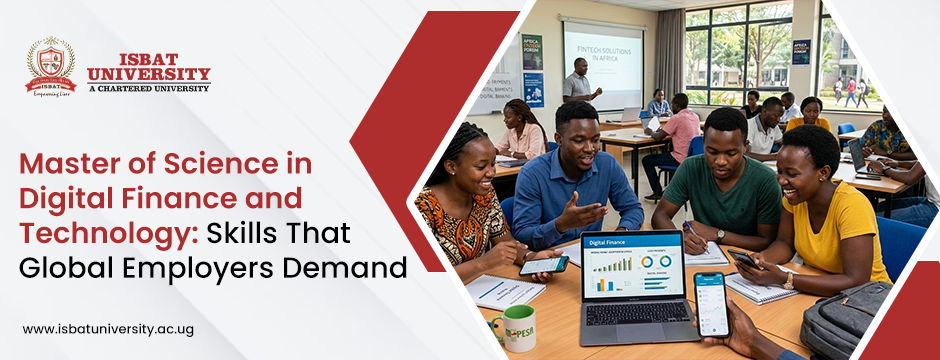
Master of Science in Digital Finance and Technology: Skills That Global Employers Demand
February 27, 2026
The financial world is changing faster than ever. Banks are becoming digital platforms. Payments move in seconds. Investment decisions are driven by algorithms. As a result, employers are no longer looking for traditional finance graduates alone. They want professionals who understand both money and technology.
This is where a Master of Science in Digital Finance and Technology becomes highly valuable. The degree blends finance, analytics, and emerging technologies into one focused pathway. However, what truly matters is the skill set it builds. In this article, we explore the exact skills global employers demand and how this qualification prepares you for them.
Why Employers Value a Master of Science in Digital Finance and Technology
Financial institutions are under pressure. They must reduce costs, improve customer experience, and stay compliant with strict regulations. At the same time, fintech startups are disrupting traditional models.
Consequently, employers need professionals who can:
- Understand financial systems
- Analyse complex data
- Implement digital solutions
- Manage technological risk
A Master of Science in Digital Finance and Technology addresses all these needs in a structured way. It prepares graduates not just to adapt to change, but to lead it.
1. Advanced Financial Analysis in a Digital Context
Financial analysis remains a core requirement. However, today it goes beyond balance sheets and ratios.
Graduates of a Digital Finance and Technology program learn:
- Financial modelling using software tools
- Risk forecasting with predictive analytics
- Portfolio optimisation using algorithms
For example, investment firms now rely on automated trading systems. These systems require professionals who understand both market theory and coding logic. This combination makes candidates highly employable.
Furthermore, companies value those who can interpret financial data from digital platforms and convert it into strategic insights.
2. Data Analytics and Decision Intelligence
Data is the backbone of modern finance. Every transaction generates information. Every customer interaction leaves a digital footprint.
An MSc in Digital Finance and Technology develops strong capabilities in:
- Big data management
- Machine learning basics
- Predictive modeling
- Data visualization
Specifically, employers seek professionals who can turn raw data into actionable decisions. For instance, digital banks analyse customer spending patterns to design personalised financial products.
Without strong analytics skills, this is impossible. Therefore, data fluency has become a non-negotiable requirement in global markets.
3. Blockchain and Digital Asset Expertise
Blockchain is no longer limited to cryptocurrency. It is now used in cross-border payments, trade finance, and digital identity systems.
A Master of Science in Digital Finance and Technology equips students with knowledge of:
- Distributed ledger technology
- Smart contracts
- Tokenisation of assets
- Regulatory implications of digital currencies
Global employers need professionals who understand both the technical architecture and financial implications of blockchain systems. For example, central banks exploring digital currencies require analysts who can evaluate security, compliance, and economic impact.
This skill set opens doors in fintech startups, consulting firms, and multinational banks.
4. Artificial Intelligence in Financial Services
Artificial Intelligence is reshaping credit scoring, fraud detection, and customer service automation.
Through a well-designed Digital Finance and Technology program, students learn:
- AI applications in lending decisions
- Fraud detection algorithms
- Robotic process automation
- Chatbot-driven banking services
Importantly, employers want candidates who can assess AI outputs critically. Blind reliance on algorithms creates risk. Skilled professionals understand model limitations and regulatory concerns.
As a result, graduates become valuable assets in AI-led financial transformation projects.
5. Digital Banking Architecture and Payment Systems
Mobile banking and digital wallets dominate many emerging markets. Meanwhile, global payment systems are becoming instant and borderless.
An MSc in Digital Finance and Technology provides insight into:
- Digital payment infrastructures
- API-based banking systems
- Cloud banking architecture
- Financial inclusion technologies
For example, understanding how payment gateways integrate with core banking systems is crucial for digital banking executives.
Employers appreciate candidates who grasp both backend systems and customer-facing platforms. This dual understanding improves operational efficiency and innovation.
6. Cybersecurity and Risk Management
With digital growth comes digital risk. Cyberattacks on financial institutions are increasing.
A Master of Science in Digital Finance and Technology prepares graduates to understand:
- Cybersecurity frameworks
- Data protection regulations
- Operational risk in fintech systems
- Compliance requirements
Specifically, global employers prioritise professionals who can identify vulnerabilities in digital financial infrastructure. Knowledge of risk governance and regulatory standards strengthens career prospects.
Consequently, graduates become suitable for roles in risk analysis and compliance management.
7. Regulatory and Ethical Intelligence
Technology moves fast. Regulations move carefully. Bridging this gap is critical.
A structured Digital Finance and Technology program trains students in:
- International financial regulations
- Anti-money laundering frameworks
- Ethical AI use in finance
- Cross-border compliance standards
For example, fintech firms operating in multiple countries must comply with different regulatory systems. Professionals who understand global frameworks reduce legal exposure.
Employers value individuals who can innovate responsibly while maintaining transparency and accountability.
8. Strategic Thinking and Innovation Leadership
Technical skills alone are not enough. Employers seek professionals who can lead transformation initiatives.
An MSc in Digital Finance and Technology encourages:
- Critical thinking
- Strategic planning
- Innovation management
- Entrepreneurial mindset
Graduates learn to evaluate emerging trends and build scalable financial solutions. For instance, launching a digital lending product requires market research, risk evaluation, and technological planning.
Therefore, leadership capability becomes a defining advantage in global hiring decisions.
Real-World Career Applications
The skills developed through a Master of Science in Digital Finance and Technology align directly with current job roles such as:
- Financial Data Analyst
- Blockchain Analyst
- Digital Banking Manager
- AI in Finance Specialist
- Investment Risk Analyst
- FinTech Product Manager
Moreover, consulting firms actively recruit candidates who can guide digital transformation strategies for banks and financial institutions.
Graduates are not limited to employment. Many launch fintech startups or pursue doctoral research in financial innovation.
How This Degree Stands Out Globally
Traditional finance degrees focus heavily on theory. Technology degrees focus on systems. However, global employers need professionals who understand both domains equally well.
The Master of Science in Digital Finance and Technology bridges this gap effectively. It integrates finance, computing, analytics, and innovation into one cohesive learning pathway.
Furthermore, the curriculum aligns with global industry trends such as AI adoption, digital currencies, and financial automation.
For students evaluating options, choosing the right MSc in Digital Finance and Technology can significantly influence long-term career mobility.
Is This the Right Path for You?
If you are interested in finance but also passionate about technology, this field offers strong potential. It suits professionals who enjoy solving complex problems using data and digital tools.
Additionally, individuals aiming to work in international banking, fintech ecosystems, or digital consulting will benefit greatly from this specialisation.
Before enrolling in a Digital Finance and Technology program, review the curriculum carefully. Look for practical projects, industry collaboration, and exposure to emerging technologies.
Empowering Global Talent Through Innovation and Excellence
At ISBAT University, we have built a strong reputation as one of the best universities in Uganda since 2006. We are a Chartered University, committed to delivering quality education that shapes holistic and empowered global citizens. With international collaborations, credit transfer opportunities, and a modern metropolitan campus in Kampala, we combine academic excellence with practical skills.
Our industry-focused approach ensures our graduates are innovative, employable, and ready to lead in today’s digital economy.
Conclusion: Building Skills That Truly Matter
The global financial ecosystem is evolving rapidly. Employers are no longer hiring based on finance knowledge alone. They demand digital fluency, analytical strength, and strategic thinking.
A Master of Science in Digital Finance and Technology equips professionals with these high-impact skills. From AI-driven analytics to blockchain strategy and regulatory intelligence, the program prepares graduates for real-world challenges.
In conclusion, this degree is more than an academic qualification. It is a pathway to becoming a future-ready financial technologist.
If you are considering advancing your expertise in this dynamic field, exploring the program offerings at ISBAT University could be a meaningful next step toward shaping your global finance career.

Since 2006, ISBAT University is ranked consistently among the top higher education institutions in Uganda.