- About
- Programs
- Faculty of Graduate Studies and Research
- PhD in Business and Management Studies
- PhD in Information and Communication Technology
- Master of Science in Information Technology (MSc.IT)
- Master of Science in Cyber Security and Forensics
- Master of Science in Digital Finance and Technology
- Master of Science in Public Health (General)
- Master of Science in Public Health – Health Informatics
- Master of Science in Public Health – Epidemiology and Biostatistics
- Master of Business Administration (MBA)
- Faculty of ICT
- Master of Science in Information Technology (MSc.IT)
- Master of Science in Cyber Security and Forensics
- Bachelor of Science in Animation and Visual Effects (B.Sc. VFX)
- Bachelor of Science in Applied Information Technology (B.Sc. AIT)
- Bachelor of Science in Artificial Intelligence and Machine Learning (B.Sc. AI & ML)
- Bachelor of Science in Networking and Cyber Security (B.Sc. NCS)
- Bachelor of Science in Computer Science (B.Sc. CS)
- Faculty of Health Sciences
- Faculty of Business & Commerce
- Master of Science in Digital Finance and Technology
- Master of Business Administration (MBA)
- Bachelor of Business Administration in International Marketing (BBA-IM)
- Bachelor of Business Administration in International Business (BBA-IB)
- Bachelor of Hotel Management (BHM)
- Bachelor of Human Resource Management (BHRM)
- Bachelor of Science in Applied Economics (BSc-AE)
- B.Sc. Accounting and Finance
- Faculty of Engineering
- Diploma Programmes
- Pre-University / International Foundation
- Short Courses (Professional / Skill-based)
- Certified Cyber Security Specialist (CCSS)
- Certified Ethical Hacker (CEH) Certification
- Computer Hacking Forensic Investigator (CHFI) Certification
- ISBAT Certified Integrated IT Infrastructure Specialist Programme
- Data Science
- Python
- Cloud Computing
- Linux for Beginners
- Cyber Security for Beginners
- Certified Network Associate (CNA)
- PMP
- Faculty of Graduate Studies and Research
- ISBAT Online
- Research & Innovation
- Alumni
- Career
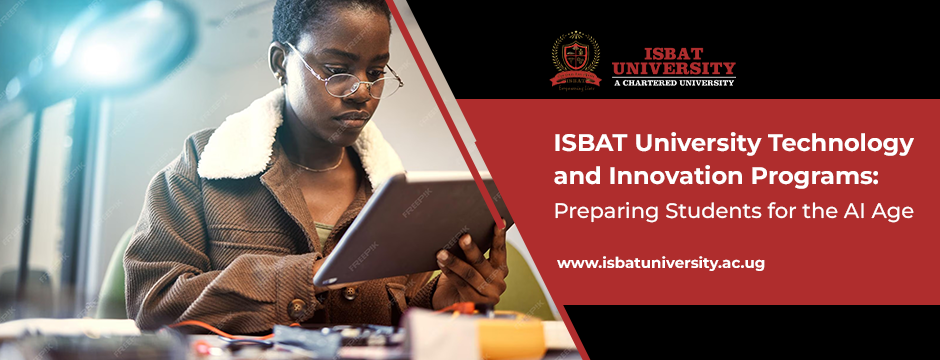
ISBAT University Technology and Innovation Programs: Preparing Students for the AI Age
February 26, 2026
In today’s fast-evolving world, technology isn’t just a sector — it’s the backbone of every industry. From healthcare to finance, education, transportation, artificial intelligence (AI), machine learning, robotics, and digital innovation are reshaping how we live, work, and solve problems. For students stepping into this dynamic era, mastering foundational and advanced technological skills has become a gateway to opportunity and impact.
While many universities offer traditional IT programs, few embed future-oriented innovation into their curricula. ISBAT University Technology and Innovation Programs stand out by integrating emerging technologies, human-centred problem solving, and entrepreneurial thinking across its technology programs. This means graduates aren’t just technically competent — they are equipped to lead transformative projects, drive organisational value, and create meaningful solutions for real-world challenges. In this blog, we’ll explore how ISBAT University’s technology and innovation programs position learners at the forefront of the AI age.
Why Technology and Innovation Education Matters Today?
The pace of technological progress is now exponential. According to global research, AI and related technologies could contribute trillions of dollars to the global economy over the next decade. In parallel, the demand for skilled professionals in software engineering, data science, AI development, cybersecurity, and innovation strategy continues to surge. Traditional educational models that focus on rote learning or narrow theory are no longer adequate — the modern learner needs multidisciplinary skills, practical exposure, and creative problem-solving abilities.
Industry 4.0 and the changing skills landscape
The Fourth Industrial Revolution — marked by cyber-physical systems, big data, the Internet of Things (IoT), and advanced automation — has blurred the lines between digital and physical realms. Today’s industries require professionals who understand both how technology works and how it can be used to solve human problems. That blend of technical depth and an innovation mindset defines future success.
This shift also means that job roles are transforming. Titles such as AI Specialist, Data Analyst, Cloud Engineer, Innovation Manager, and Human-Computer Interaction Designer are increasingly common. Many traditional roles now embed digital competencies. For students to contribute meaningfully to this landscape, their education must move beyond theory to experiential learning, industry collaboration, and real project execution.
ISBAT University’s Approach to Technology & Innovation
ISBAT University Technology and Innovation Programs understands that preparing students for the AI age requires more than teaching programming languages or basic software skills. Their approach focuses on intelligent curriculum design, experiential learning pathways, industry certifications, and entrepreneurial integration. Here’s how these elements work together.
Future-Focused Curriculum
The curriculum at ISBAT University is designed around current and emerging industry demands:
- Computing & AI Foundations: Students explore programming, algorithms, data structures, and computational thinking — the building blocks for all advanced tech roles.
- Machine Learning & AI Methods: Learners work with modern AI methodologies, including neural networks, NLP, and reinforcement learning.
- Cybersecurity & Network Technology: With digital risk rising, students gain skills in secure systems design, ethical hacking, and defensive architectures.
This layered structure ensures that students build strong fundamentals first before advancing to more complex domains.
Project-Centred and Interdisciplinary Learning
Learning at ISBAT University isn’t confined to textbooks. Students engage in hands-on projects that require teamwork, critical thinking, and real execution.
- Capstone Projects: Students solve real business problems using AI, automation, or analytics.
- Interdisciplinary Collaboration: Tech learners work alongside business, design, and social science students, preparing them for real-world collaboration.
This format helps students transition from passive learners to problem solvers who can build functioning applications, dashboards, automated workflows, and AI proofs-of-concept.
Industry Integration and Career Preparation
One of the biggest differentiators of ISBAT University is its emphasis on industry connectivity. Technology evolves quickly, and curricular relevance depends on engagement with active industry trends.
Partnerships and Guest Lecturers
Students benefit from guest lectures, industry panels, and mentorship from tech leaders. These interactions expose learners to real-world challenges, current tools, and practical work expectations.
Internships and Hands-on Industry Work
AI engineering Uganda at ISBAT University have access to industry internships that allow them to apply skills in live environments. These experiences not only reinforce academic learning but also help students build professional networks and understand workplace dynamics.
Certification Integration
By integrating globally recognised certifications into programs — such as cloud credentials, AI tool certifications, and cybersecurity badges — students graduate with credentials that signal job readiness. This increases employability and accelerates early career growth.
Equipping Students for Innovation and Entrepreneurship
Study after study has shown that the most successful tech professionals are those who can marry technical competence with creative thinking. ISBAT University nurtures this blend through:
- Innovation Labs: Spaces where students experiment with emerging tech tools, robotics kits, virtual environments, and collaboration platforms.
- Startup Incubation Support: Students with entrepreneurial ideas receive mentoring, access to resources, and guidance on venture development.
- Design Thinking Workshops: These help students frame problems from a human perspective, ideate effectively, and prototype solutions rapidly.
This ecosystem helps students not just prepare for jobs, but also create new opportunities — from launching startups to leading innovation teams within organisations.
Navigating the AI-Driven Workforce
Today’s graduates enter a workforce that values adaptability, lifelong learning, and technological fluency. The AI age isn’t static — it demands continuous evolution. ISBAT University equips students with the ability to:
- Learn new tools rapidly
- Interpret data for decision making
- Build intelligent solutions
- Collaborate across disciplines
- Communicate technical work to stakeholders
In essence, students are prepared not only for their first job but for a career of growth, innovation, and impactful contribution.
End Words
As the world accelerates into an AI-driven future, the value of a technology education that blends deep knowledge with practical innovation grows ever stronger. ISBAT University Technology and Innovation Programs are structured to cultivate not just programmers, but future-ready thinkers and doers. Through forward-looking curricula, hands-on projects, industry integration, and entrepreneurial support, students are positioned to thrive in competitive and transformative fields.
For those looking to build a career that thrives in the age of AI — one defined by creativity, technical excellence, and real-world impact — ISBAT University offers a pathway that aligns with the demands of tomorrow’s workforce. Explore more about our technology and innovation programs and take the first step toward shaping the future of technology with confidence.
Since 2006, ISBAT University is ranked consistently among the top higher education institutions in Uganda.