- About
- Programs
- Faculty of Graduate Studies and Research
- PhD in Business and Management Studies
- PhD in Information and Communication Technology
- Master of Science in Information Technology (MSc.IT)
- Master of Science in Cyber Security and Forensics
- Master of Science in Digital Finance and Technology
- Master of Science in Public Health (General)
- Master of Science in Public Health – Health Informatics
- Master of Science in Public Health – Epidemiology and Biostatistics
- Master of Business Administration (MBA)
- Faculty of ICT
- Master of Science in Information Technology (MSc.IT)
- Master of Science in Cyber Security and Forensics
- Bachelor of Science in Animation and Visual Effects (B.Sc. VFX)
- Bachelor of Science in Applied Information Technology (B.Sc. AIT)
- Bachelor of Science in Artificial Intelligence and Machine Learning (B.Sc. AI & ML)
- Bachelor of Science in Networking and Cyber Security (B.Sc. NCS)
- Bachelor of Science in Computer Science (B.Sc. CS)
- Faculty of Health Sciences
- Faculty of Business & Commerce
- Master of Science in Digital Finance and Technology
- Master of Business Administration (MBA)
- Bachelor of Business Administration in International Marketing (BBA-IM)
- Bachelor of Business Administration in International Business (BBA-IB)
- Bachelor of Hotel Management (BHM)
- Bachelor of Human Resource Management (BHRM)
- Bachelor of Science in Applied Economics (BSc-AE)
- B.Sc. Accounting and Finance
- Faculty of Engineering
- Diploma Programmes
- Pre-University / International Foundation
- Short Courses (Professional / Skill-based)
- Certified Cyber Security Specialist (CCSS)
- Certified Ethical Hacker (CEH) Certification
- Computer Hacking Forensic Investigator (CHFI) Certification
- ISBAT Certified Integrated IT Infrastructure Specialist Programme
- Data Science
- Python
- Cloud Computing
- Linux for Beginners
- Cyber Security for Beginners
- Certified Network Associate (CNA)
- PMP
- Faculty of Graduate Studies and Research
- ISBAT Online
- Research & Innovation
- Alumni
- Career
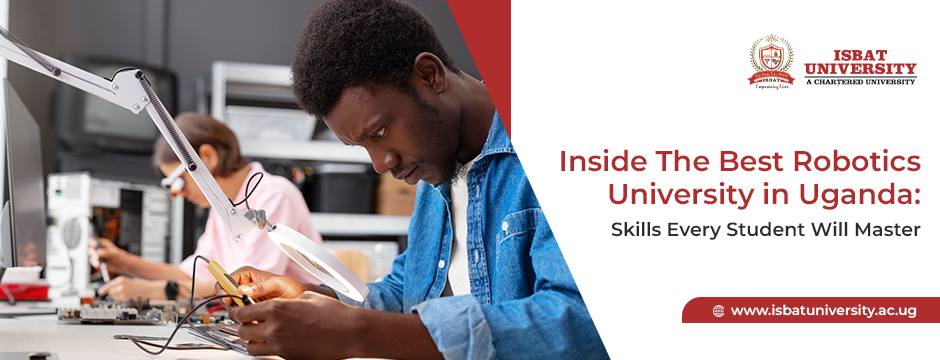
Inside The Best Robotics University in Uganda: Skills Every Student Will Master
February 26, 2026
Robotics is no longer a futuristic idea. It already shapes healthcare, mobility, manufacturing, and daily human experiences. Students drawn to innovation often seek programs blending engineering depth with real-world impact. The best robotics university in Uganda, ISBAT University, is designed for curious minds ready to build intelligent systems that matter.
This blog explores the skills students steadily master during the course, while highlighting how learning transforms into purpose-driven careers.
Why Robotics And Artificial Intelligence Matter Today?
Industries increasingly rely on intelligent automation to solve complex problems. Robotics and AI sit at the centre of this transformation.
From autonomous vehicles to surgical robots, technology now collaborates with humans. Students entering this field require more than theory. They need structured learning, ethical grounding, and practical exposure.
ISBAT University frames robotics education around these exact needs, preparing students for Industry 4.0 and beyond.
A Strong Engineering Foundation Comes First
Every capable robotic system rests on solid engineering principles. The program begins by strengthening fundamentals that support advanced learning later.
Core Engineering And Mathematics Skills
Students develop confidence in mathematics, physics, and system modelling. These skills support control systems, motion planning, and algorithm design.
Engineering mechanics and electronics help learners understand how machines move and respond. This foundation ensures concepts remain practical rather than abstract.
Programming for Intelligent Systems
Programming becomes a daily language rather than a standalone subject. Students work with structured and object-oriented programming concepts. Logical thinking improves as code connects directly with hardware behavior.
Over time, programming related to robotics and AI education in Uganda evolves into a creative tool for solving engineering challenges.
Coding Skills That Power Robotics Innovation
Robotics thrives on software intelligence. Coding skills move beyond syntax toward purposeful design and system thinking.
Algorithm Development & Logic Building
Students learn how algorithms guide decision-making inside robots. Concepts like path planning, sensor fusion, and optimization become intuitive through repeated application. Logical reasoning improves as students test and refine solutions.
Software Integration with Hardware
Robotic systems require seamless coordination between code and components. Learners integrate software with sensors, actuators, and controllers. This experience builds confidence in handling real machines rather than simulations alone.
Automation And Control Systems Mastery
Automation defines how robots interact with environments. This course places strong emphasis on control systems and industrial relevance.
Understanding Control Theory
Students explore feedback systems, stability, and response tuning. These concepts help robots maintain balance and accuracy. Control theory becomes practical through lab experiments and case-based learning.
Industrial Automation Applications
Automation knowledge connects directly to manufacturing and smart systems. Students study programmable controllers and automated workflows. These skills translate well into industrial automation and smart manufacturing roles.
Machine Learning Skills for Smarter Robots
Modern robots learn, adapt, and improve. Machine learning provides this intelligence.
Foundations of Machine Learning
Students at the best robotics university in Uganda understand supervised and unsupervised learning concepts. Models are trained to recognize patterns and make predictions. Learning remains application-focused rather than purely mathematical.
AI in Real Robotic Scenarios
Machine learning supports navigation, object detection, and decision-making. Students apply models within robotic frameworks. This connection helps learners see how AI directly influences physical outcomes.
Computer Vision & Perception Capabilities
Robots must interpret the world accurately. Computer vision teaches machines to see and understand environments.
Image Processing As Well As Visual Recognition
Students learn how cameras capture data and extract useful information. Techniques like feature detection and classification improve robotic perception.
These skills apply across healthcare, security, and autonomous systems.
Vision-Based Robotic Applications
Visual intelligence enables robots to identify objects and navigate spaces. Learners explore real-world use cases through projects and labs. Vision-based systems become an exciting, creative domain rather than a technical mystery.
Hands-On Labs That Build Real Confidence
Theory gains meaning through practice. ISBAT University emphasizes experiential learning throughout the program.
Advanced Robotics Laboratories
Students work inside modern labs equipped with robotic platforms and simulation tools. Experiments mirror real engineering problems. This exposure reduces the gap between classroom learning and industry expectations.
Project-Based Learning Approach
Projects encourage teamwork and independent thinking. Students design, test, and improve robotic systems collaboratively. This process of robotics and AI education in Uganda strengthens problem-solving skills and technical communication.
Research, Innovation & Critical Thinking
Robotics education should inspire inquiry and creativity. The program supports research-driven exploration.
Research Methodology And Exploration
Students learn how to approach problems systematically. Research skills support innovation and academic growth. Learners explore emerging technologies and unresolved challenges.
Encouraging Innovation & Entrepreneurship
Creative thinking receives structured encouragement. Students explore startup ideas and interdisciplinary solutions. Robotics becomes a platform for societal improvement rather than a limited technical output.
Ethical And Social Responsibility in Robotics
Technology shapes societies. Ethical awareness becomes essential for responsible innovation.
Understanding Ethical AI Deployment
Students examine ethical concerns around automation and data use. Discussions cover privacy, bias, and environmental impact. These lessons guide responsible system design.
Robotics for Societal Benefit
The curriculum highlights positive applications in healthcare, agriculture, and smart cities. Students learn how technology can improve lives. Purpose-driven learning remains central throughout the course.
Communication & Team Collaboration Skills
Technical brilliance matters little without collaboration. The program builds soft skills alongside engineering expertise.
Technical Communication Excellence
Students practice presenting ideas clearly and confidently. Reports, presentations, and discussions refine communication abilities. These skills support careers in industry and academia.
Multidisciplinary Team Experience
Robotics projects involve diverse expertise. Students at the best robotics university in Uganda collaborate across engineering, computing, and research domains. Adaptability and teamwork become natural strengths.
Career Opportunities after Graduation
The B.E. in Robotics & AI opens doors across industries. Graduates find roles in technology-driven sectors worldwide.
In-Demand Job Roles
Graduates pursue careers as Robotics Engineers, AI Engineers, and Automation Specialists. Roles also include Machine Learning and Computer Vision Engineers. Research-focused students explore academic and innovation-driven positions.
Expanding Industry Sectors
Robotics skills apply to healthcare, aerospace, and smart cities. Agriculture and service robotics offer meaningful societal impact. Startups welcome graduates with practical and creative mindsets.
Pathways for Higher Studies And Research
Many graduates choose academic advancement. The program supports this ambition naturally.
Advanced Degrees Along with Specializations
Students pursue M.Tech, M.S., or PhD programs globally. Specializations include space robotics and human-AI interaction. Research-driven careers remain achievable and rewarding.
Why ISBAT University Stands Out?
ISBAT University combines academic excellence with a global perspective. Charter status reflects institutional credibility and commitment.
Diverse faculty bring creativity, experience, and industry insight. Students benefit from mentorship, exposure, and practical learning environments. The university nurtures engineers ready to innovate responsibly and confidently.
Final Thoughts
Robotics education should inspire confidence, curiosity, and responsibility. The B.E. in Robotics & Artificial Intelligence at ISBAT University delivers all three. Students graduate with strong technical foundations, hands-on experience, and ethical awareness.
Skills extend beyond machines into leadership and collaboration. For aspiring innovators seeking meaningful careers, this course offers more than education. It offers direction, purpose, and the tools to shape tomorrow’s intelligent world. So, if you’re also in robotics, enroll at the best robotics university in Uganda.
Since 2006, ISBAT University is ranked consistently among the top higher education institutions in Uganda.