- About
- Programs
- Faculty of Graduate Studies and Research
- PhD in Business and Management Studies
- PhD in Information and Communication Technology
- Master of Science in Information Technology (MSc.IT)
- Master of Science in Cyber Security and Forensics
- Master of Science in Digital Finance and Technology
- Master of Science in Public Health (General)
- Master of Science in Public Health – Health Informatics
- Master of Science in Public Health – Epidemiology and Biostatistics
- Master of Business Administration (MBA)
- Faculty of ICT
- Master of Science in Information Technology (MSc.IT)
- Master of Science in Cyber Security and Forensics
- Bachelor of Science in Animation and Visual Effects (B.Sc. VFX)
- Bachelor of Science in Applied Information Technology (B.Sc. AIT)
- Bachelor of Science in Artificial Intelligence and Machine Learning (B.Sc. AI & ML)
- Bachelor of Science in Networking and Cyber Security (B.Sc. NCS)
- Bachelor of Science in Computer Science (B.Sc. CS)
- Faculty of Health Sciences
- Faculty of Business & Commerce
- Master of Science in Digital Finance and Technology
- Master of Business Administration (MBA)
- Bachelor of Business Administration in International Marketing (BBA-IM)
- Bachelor of Business Administration in International Business (BBA-IB)
- Bachelor of Hotel Management (BHM)
- Bachelor of Human Resource Management (BHRM)
- Bachelor of Science in Applied Economics (BSc-AE)
- B.Sc. Accounting and Finance
- Faculty of Engineering
- Diploma Programmes
- Pre-University / International Foundation
- Short Courses (Professional / Skill-based)
- Certified Cyber Security Specialist (CCSS)
- Certified Ethical Hacker (CEH) Certification
- Computer Hacking Forensic Investigator (CHFI) Certification
- ISBAT Certified Integrated IT Infrastructure Specialist Programme
- Data Science
- Python
- Cloud Computing
- Linux for Beginners
- Cyber Security for Beginners
- Certified Network Associate (CNA)
- PMP
- Faculty of Graduate Studies and Research
- ISBAT Online
- Research & Innovation
- Alumni
- Career
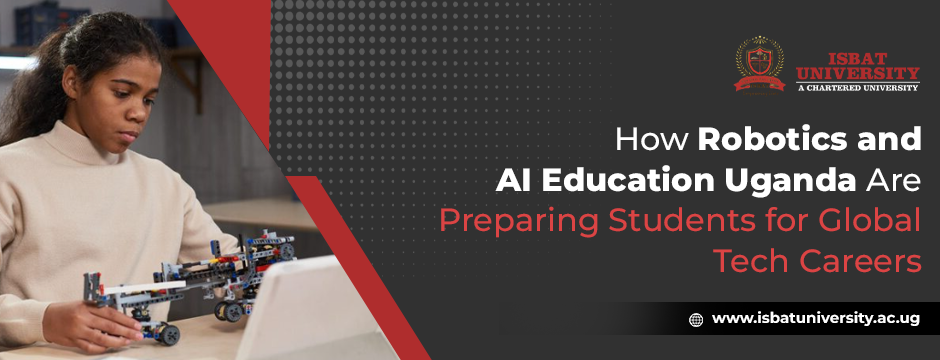
How Robotics and AI Education Uganda Are Preparing Students for Global Tech Careers
February 26, 2026
Technology is rapidly reshaping the global economy, and robotics and artificial intelligence (AI) are at the center of this transformation. From automated manufacturing and smart healthcare systems to self-driving vehicles and intelligent software, robotics and AI are no longer futuristic concepts; they are essential tools driving innovation worldwide. As demand for skilled professionals grows, countries across Africa, including Uganda, are investing heavily in robotics and AI education to prepare the next generation of engineers for global opportunities.
Robotics and AI education Uganda is evolving beyond basic computer science to focus on advanced engineering, intelligent systems, automation, and real-world problem solving. Students are no longer limited to theoretical knowledge; instead, they are gaining hands-on experience with emerging technologies that align with international industry standards. This shift is enabling Ugandan graduates to compete in global tech markets, contribute to multinational projects, and create solutions that address both local and international challenges.
As global companies increasingly seek talent with interdisciplinary skills, combining programming, electronics, data analysis, and systems thinking, robotics and AI education has become a powerful pathway to high-impact careers. This blog explores how robotics and AI education across Uganda is equipping students with globally relevant skills, fostering innovation, and opening doors to international tech careers.
The Global Demand for Robotics and AI Skills
Across industries, robotics and AI professionals are among the most sought-after talents. According to global labor trends, employers are prioritizing skills in machine learning, automation, robotics design, data science, and intelligent control systems. These technologies power everything from smart factories and fintech platforms to medical robotics and space exploration.
For students in Uganda, robotics and AI education provide access to this expanding global job market. By mastering technologies used worldwide, graduates can pursue careers in multinational companies, remote tech roles, research institutions, and startups operating on a global scale.
A Strong Engineering Foundation for International Careers
Robotics and AI education Uganda emphasizes a solid engineering foundation. Students typically study core subjects such as:
- Mathematics and applied physics
- Electronics and embedded systems
- Programming languages like Python, C++, and Java
- Control systems and automation
- Artificial intelligence and machine learning principles
This multidisciplinary approach mirrors engineering programs in leading global institutions, ensuring that graduates are academically aligned with international standards. A strong foundation allows students to adapt quickly to new technologies and work environments, a critical requirement for global tech careers.
Hands-On Learning and Practical Skill Development
One of the most important aspects of robotics and AI education is practical, hands-on experience. Modern programs in Uganda increasingly integrate:
- Robotics labs and simulations
- AI model development and testing
- Automation projects and system design
- Capstone projects solving real-world problems
These experiences help students move beyond theory and develop problem-solving, debugging, and design skills that global employers value. By working on real systems, students learn how to collaborate, manage projects, and apply technology in practical contexts, key competencies in international tech roles.
Alignment With Industry 4.0 and Global Standards
Industry 4.0 focuses on smart manufacturing, cyber-physical systems, and data-driven decision-making. Robotics and AI education are increasingly aligned with these concepts, preparing students for industries undergoing digital transformation. Therefore, enrolling in the best robotics university in Uganda, like ISBAT University, can be advantageous for students, ensuring career growth.
Students gain exposure to technologies such as:
- Internet of Things (IoT) integration
- Intelligent automation systems
- Predictive analytics and data-driven control
- Human-robot interaction
This alignment ensures that graduates can seamlessly transition into global industries where these technologies are already in use.
Preparing Students for Remote and International Work
Global tech careers are no longer limited by geography. Many robotics and AI professionals work remotely or collaborate across borders. Robotics and AI education Uganda helps students develop:
- Strong programming and software development skills
- Analytical thinking and independent problem-solving abilities
- Communication skills for technical collaboration
- Experience with globally used tools and platforms
These skills are essential for remote engineering roles, international research teams, and global startups, allowing Ugandan graduates to participate in the worldwide tech ecosystem.
Encouraging Innovation and Entrepreneurship
Robotics and AI education also fosters innovation and entrepreneurship. Students are encouraged to design solutions that address real challenges such as healthcare access, agricultural automation, smart cities, and sustainable energy.
By combining global technologies with local problem-solving, graduates develop an entrepreneurial mindset that is valuable both locally and internationally. Many global tech careers emerge from startups, research initiatives, and innovation hubs, areas where robotics and AI graduates thrive.
Supporting Diverse and Inclusive Global Tech Participation
Robotics and AI education play an important role in diversifying the global tech workforce. By providing access to advanced engineering education, it enables students from diverse backgrounds to contribute to international innovation.
Inclusive education strengthens global collaboration by bringing new perspectives, cultural insights, and problem-solving approaches into the tech industry. This diversity is increasingly recognized as a competitive advantage in global engineering and AI development.
Exposure to Global Research, Ethics, and Emerging Technologies
Robotics and AI education are increasingly incorporating global research trends and ethical awareness into their curriculum. As artificial intelligence systems become more influential in areas such as healthcare, finance, transportation, and governance, engineers are expected to understand not only how these systems are built, but also how they affect people and societies. This broader perspective is essential for students who aspire to work in international and cross-border technology environments.
By developing an understanding of ethical responsibility alongside technical expertise, graduates are better prepared to contribute to research-driven projects and internationally compliant technology solutions. This balanced approach strengthens their readiness for global careers, where ethical decision-making and technological excellence go hand in hand
Building Soft Skills for Global Success
Beyond technical knowledge, robotics and AI education help students develop essential soft skills, including:
- Critical thinking and adaptability
- Teamwork and leadership
- Ethical awareness in AI development
- Cross-cultural collaboration
These skills are crucial for working in international environments, managing complex projects, and navigating the ethical challenges of emerging technologies.
Final Thoughts
Robotics and AI education Uganda is rapidly becoming a gateway to global tech careers. By combining strong engineering foundations, hands-on learning, industry-aligned curricula, and innovation-driven thinking, students are being prepared to compete and succeed on the world stage.
For those seeking a structured and future-focused pathway into this field, programs such as the Bachelor of Engineering in Robotics and Artificial Intelligence can enroll at ISBAT University. At ISBAT University, we provide the academic rigor, practical exposure, and global relevance needed to thrive in international tech careers. As robotics and AI continue to shape the future, investing in high-quality education with us today opens doors to limitless global opportunities tomorrow.
Since 2006, ISBAT University is ranked consistently among the top higher education institutions in Uganda.