- About
- Programs
- Faculty of Graduate Studies and Research
- PhD in Business and Management Studies
- PhD in Information and Communication Technology
- Master of Science in Information Technology (MSc.IT)
- Master of Science in Cyber Security and Forensics
- Master of Science in Digital Finance and Technology
- Master of Science in Public Health (General)
- Master of Science in Public Health – Health Informatics
- Master of Science in Public Health – Epidemiology and Biostatistics
- Master of Business Administration (MBA)
- Faculty of ICT
- Master of Science in Information Technology (MSc.IT)
- Master of Science in Cyber Security and Forensics
- Bachelor of Science in Animation and Visual Effects (B.Sc. VFX)
- Bachelor of Science in Applied Information Technology (B.Sc. AIT)
- Bachelor of Science in Artificial Intelligence and Machine Learning (B.Sc. AI & ML)
- Bachelor of Science in Networking and Cyber Security (B.Sc. NCS)
- Bachelor of Science in Computer Science (B.Sc. CS)
- Faculty of Health Sciences
- Faculty of Business & Commerce
- Master of Science in Digital Finance and Technology
- Master of Business Administration (MBA)
- Bachelor of Business Administration in International Marketing (BBA-IM)
- Bachelor of Business Administration in International Business (BBA-IB)
- Bachelor of Hotel Management (BHM)
- Bachelor of Human Resource Management (BHRM)
- Bachelor of Science in Applied Economics (BSc-AE)
- B.Sc. Accounting and Finance
- Faculty of Engineering
- Diploma Programmes
- Pre-University / International Foundation
- Short Courses (Professional / Skill-based)
- Certified Cyber Security Specialist (CCSS)
- Certified Ethical Hacker (CEH) Certification
- Computer Hacking Forensic Investigator (CHFI) Certification
- ISBAT Certified Integrated IT Infrastructure Specialist Programme
- Data Science
- Python
- Cloud Computing
- Linux for Beginners
- Cyber Security for Beginners
- Certified Network Associate (CNA)
- PMP
- Faculty of Graduate Studies and Research
- ISBAT Online
- Research & Innovation
- Alumni
- Career
How ISBAT University Prepares Students for the 4th Industrial Revolution
June 8, 2026
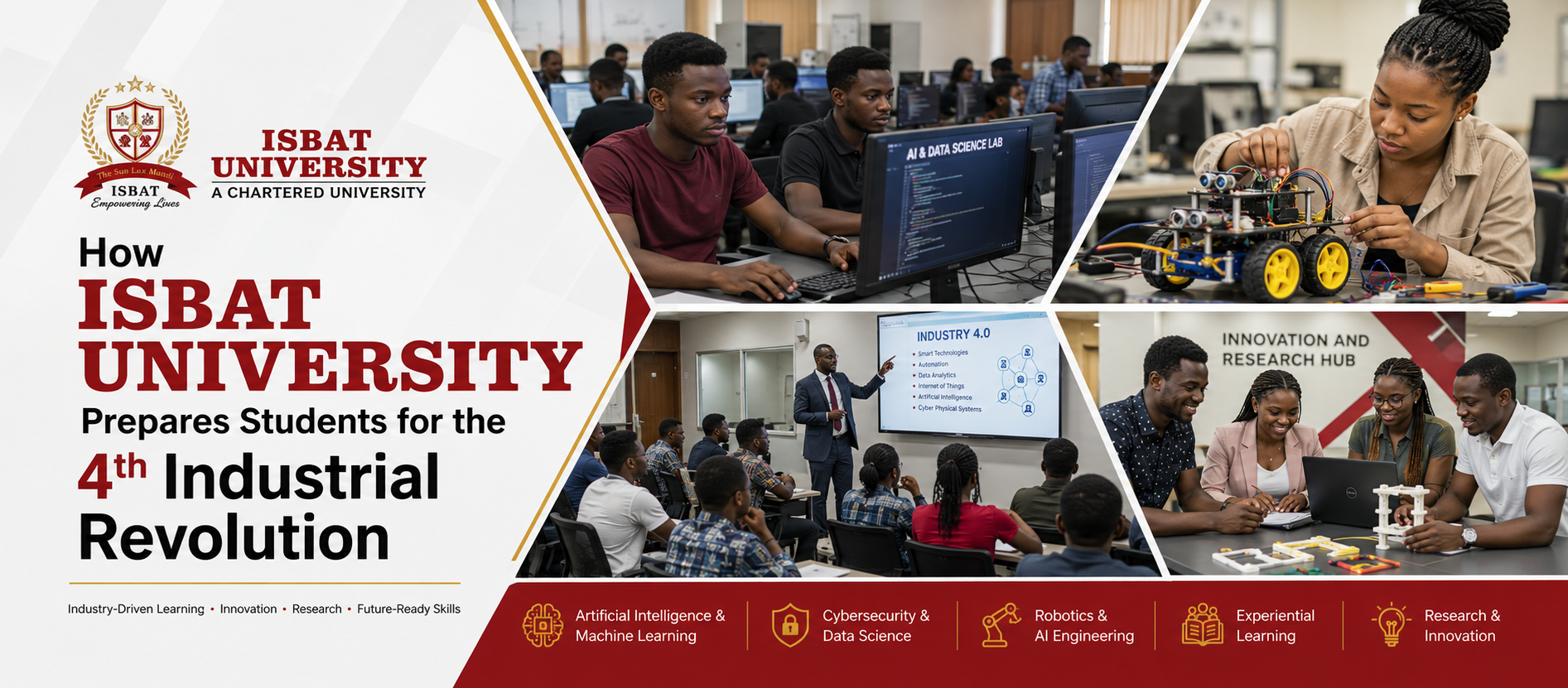
The world of work is changing faster than ever before. New technologies are reshaping industries, redefining job roles, and creating opportunities that did not exist a decade ago. This shift, often referred to as the Fourth Industrial Revolution, is driven by advancements in artificial intelligence, data science, automation, cybersecurity, and digital communication.
For students, this transformation brings both opportunity and uncertainty. Traditional education models are no longer enough. Employers are not only looking for degrees. They want graduates who can think critically, solve real problems, adapt quickly, and work with modern tools and technologies.
This is where institutions like the International School of Business and Technology play a vital role. A modern Business and technology university Uganda must go beyond classroom teaching and focus on preparing students for real-world challenges. ISBAT University has built its approach around this very idea.
The 4th Industrial Revolution
Before exploring how students are prepared, it is important to understand what the Fourth Industrial Revolution really means.
It is not just about technology. It is about the integration of digital systems into everyday life and business. Technologies such as artificial intelligence, machine learning, the Internet of Things, robotics, and data analytics are now part of almost every industry.
From banking and healthcare to manufacturing and education, every sector is evolving. Jobs are becoming more skill-driven. Routine tasks are being automated, while new roles are emerging that require creativity, analytical thinking, and technical knowledge.
Students today must be ready for jobs that may not yet exist. This requires a different kind of education.
Bridging the Gap Between Education and Industry
One of the biggest challenges in higher education is the gap between what students learn and what employers expect. Many graduates struggle because they lack practical exposure.
At ISBAT University, this gap is addressed through a strong focus on applied learning. Students are not limited to theory. They are encouraged to work on real projects, case studies, and industry-based assignments.
This approach helps students:
- Understand how concepts are used in real situations
- Develop problem-solving skills
- Gain confidence before entering the workforce
By the time students graduate, they are not just knowledgeable. They are capable of contributing from day one.
Industry-Relevant Curriculum
A key part of preparing students for the Fourth Industrial Revolution is ensuring that the curriculum stays relevant.
ISBAT University continuously updates its programs to match current industry needs. Courses are designed with input from professionals and experts, ensuring that students learn what actually matters in the job market.
In fields like Information and Communication Technology, students are introduced to areas such as:
- Artificial intelligence
- Cybersecurity
- Data science
- Software development
- Networking and cloud technologies
In business programs, students learn:
- Digital marketing
- Business analytics
- Financial management
- Global business strategies
This balance between business and technology is essential in today’s world, where almost every business relies on digital systems.
Focus on Practical Learning
Learning by doing is one of the most effective ways to build skills. ISBAT University places strong emphasis on hands-on training.
Students have access to:
- Advanced computer labs
- Technology-enabled classrooms
- Practical workshops
- Simulation-based learning
They work on projects that reflect real industry challenges. For example, a student studying cybersecurity may work on identifying system vulnerabilities. A business student may analyze market trends and create strategies.
This kind of exposure ensures that students are not overwhelmed when they enter professional environments.
Building Digital Skills
Digital literacy is no longer optional. It is a basic requirement across all industries.
ISBAT University ensures that students develop strong digital skills regardless of their chosen field. Even students in business or health sciences are trained to use digital tools effectively.
Some of the key skills students develop include:
- Data analysis and interpretation
- Use of digital platforms and tools
- Understanding of online systems and security
- Communication using digital channels
These skills make students adaptable and ready to work in modern environments.
Encouraging Innovation and Creativity
The Fourth Industrial Revolution rewards those who can think differently. Innovation is not limited to technology. It applies to business ideas, problem-solving approaches, and new ways of working.
At ISBAT University, students are encouraged to think creatively. They are given opportunities to:
- Work on innovative projects
- Participate in competitions
- Collaborate with peers from different disciplines
This environment helps students develop confidence in their ideas and the ability to turn those ideas into practical solutions.
Exposure to Real-World Challenges
Understanding theory is important, but applying it in real situations is what truly prepares students.
ISBAT University integrates real-world exposure into its programs through:
- Industry projects
- Internships
- Guest lectures from professionals
- Case study analysis
Students learn how businesses operate, how decisions are made, and how challenges are addressed. This exposure gives them a clearer understanding of their future careers.
Developing Soft Skills
Technical knowledge alone is not enough. Employers look for individuals who can communicate effectively, work in teams, and adapt to changing environments.
ISBAT University focuses on developing these essential skills alongside academic learning.
Students are trained in:
- Communication and presentation
- Teamwork and collaboration
- Leadership and decision-making
- Time management
These skills play a crucial role in career growth and long-term success.
Preparing for Global Opportunities
The job market is no longer limited by geography. Many students aim to work with international companies or pursue opportunities abroad.
ISBAT University prepares students for this global environment by:
- Offering internationally relevant programs
- Encouraging diverse perspectives
- Providing exposure to global trends
Students graduate with the confidence to compete not only locally but also internationally.
Adapting to Rapid Change
One of the defining features of the Fourth Industrial Revolution is constant change. Technologies evolve quickly, and professionals must keep learning throughout their careers.
ISBAT University instills a mindset of continuous learning. Students are encouraged to stay curious, update their skills, and remain open to new ideas.
This mindset ensures that they remain relevant even as industries evolve.
Supporting Career Readiness
Education is ultimately about building a successful career. ISBAT University supports students in this journey through career-focused initiatives.
Students receive guidance on:
- Career planning
- Resume building
- Interview preparation
- Job search strategies
This support helps students transition smoothly from education to employment.
A Strong Foundation for the Future
The Fourth Industrial Revolution is not just about technology. It is about how individuals think, adapt, and contribute to society.
ISBAT University focuses on building a strong foundation that combines:
- Knowledge
- Skills
- Practical experience
- Personal development
This balanced approach ensures that students are not only job-ready but also future-ready.
About ISBAT University
At ISBAT University, we believe that education should prepare students for real life, not just exams. As a leading Business and technology university Uganda, we focus on creating an environment where students can grow, explore, and build meaningful careers. We combine practical learning, modern infrastructure, and industry-focused programs to ensure our students are ready for the demands of the modern world. Through our commitment to quality education and continuous improvement, we aim to shape individuals who can contribute confidently to a fast-changing global landscape.
Conclusion
The Fourth Industrial Revolution is transforming the way we live and work. For students, this means preparing for a future that demands flexibility, creativity, and strong technical skills.
Choosing the right university plays a critical role in this journey. Institutions like the International School of Business and Technology are redefining education by focusing on practical learning, industry relevance, and overall development.
ISBAT University stands out by preparing students not just to adapt to change, but to lead it. With the right mix of knowledge, skills, and experience, students are empowered to succeed in a world that continues to evolve.
Frequently Asked Questions
1. What is the 4th Industrial Revolution and why is it important for students?
The 4th Industrial Revolution refers to the integration of advanced technologies like artificial intelligence, data science, and automation into everyday industries. It is important for students because it is reshaping job roles and requires new skills for future careers.
2. How does the International School of Business and Technology prepare students for modern careers?
The International School of Business and Technology focuses on practical learning, industry-relevant curriculum, and real-world exposure to ensure students gain skills that match current job market demands.
3. What skills are essential for success in the 4th Industrial Revolution?
Students need a mix of technical and soft skills, including digital literacy, problem-solving, critical thinking, communication, and adaptability to succeed in a fast-changing work environment.
4. Does ISBAT University offer practical learning opportunities?
Yes, ISBAT University emphasizes hands-on learning through projects, labs, internships, and industry-based assignments to help students apply their knowledge in real-world situations.
5. Why choose a Business and technology university Uganda for future-ready education?
A Business and technology university Uganda provides a balanced education in both technical and business skills, preparing students for diverse career opportunities in a digital and global economy.
Since 2006, ISBAT University is ranked consistently among the top higher education institutions in Uganda.