- About
- Programs
- Faculty of Graduate Studies and Research
- PhD in Business and Management Studies
- PhD in Information and Communication Technology
- Master of Science in Information Technology (MSc.IT)
- Master of Science in Cyber Security and Forensics
- Master of Science in Digital Finance and Technology
- Master of Science in Public Health (General)
- Master of Science in Public Health – Health Informatics
- Master of Science in Public Health – Epidemiology and Biostatistics
- Master of Business Administration (MBA)
- Faculty of ICT
- Master of Science in Information Technology (MSc.IT)
- Master of Science in Cyber Security and Forensics
- Bachelor of Science in Animation and Visual Effects (B.Sc. VFX)
- Bachelor of Science in Applied Information Technology (B.Sc. AIT)
- Bachelor of Science in Artificial Intelligence and Machine Learning (B.Sc. AI & ML)
- Bachelor of Science in Networking and Cyber Security (B.Sc. NCS)
- Bachelor of Science in Computer Science (B.Sc. CS)
- Faculty of Health Sciences
- Faculty of Business & Commerce
- Master of Science in Digital Finance and Technology
- Master of Business Administration (MBA)
- Bachelor of Business Administration in International Marketing (BBA-IM)
- Bachelor of Business Administration in International Business (BBA-IB)
- Bachelor of Hotel Management (BHM)
- Bachelor of Human Resource Management (BHRM)
- Bachelor of Science in Applied Economics (BSc-AE)
- B.Sc. Accounting and Finance
- Faculty of Engineering
- Diploma Programmes
- Pre-University / International Foundation
- Short Courses (Professional / Skill-based)
- Certified Cyber Security Specialist (CCSS)
- Certified Ethical Hacker (CEH) Certification
- Computer Hacking Forensic Investigator (CHFI) Certification
- ISBAT Certified Integrated IT Infrastructure Specialist Programme
- Data Science
- Python
- Cloud Computing
- Linux for Beginners
- Cyber Security for Beginners
- Certified Network Associate (CNA)
- PMP
- Faculty of Graduate Studies and Research
- ISBAT Online
- Research & Innovation
- Alumni
- Career
AI Careers That Will Grow in the Next 5 Years
February 25, 2026
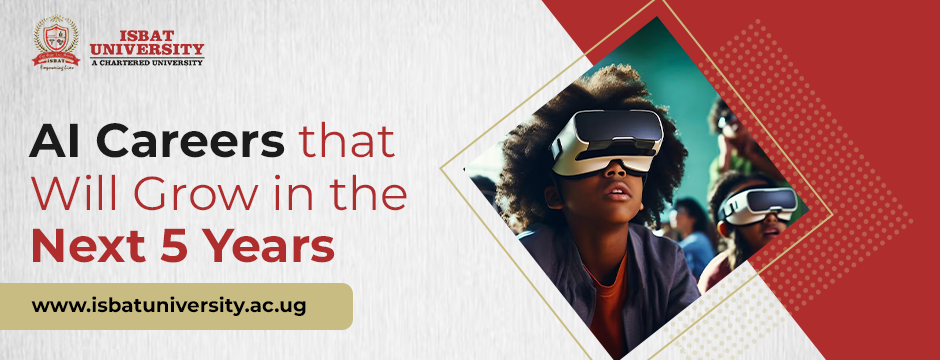
Artificial Intelligence (AI) is no longer a futuristic concept; it is reshaping industries, redefining workflows, and creating new career opportunities at an unprecedented pace. As organizations across the globe embrace AI-driven transformation, the demand for professionals who can develop, implement, and manage AI systems is skyrocketing. For students and professionals looking to future-proof their careers, understanding which AI careers will grow in the next five years is crucial. Choosing the best university for AI and robotics in Uganda can also be a pivotal step in acquiring the knowledge, hands-on skills, and industry exposure needed to thrive in this rapidly evolving field.
The AI job landscape is diverse, spanning technical, analytical, managerial, and ethical roles. By 2030, it is expected that the AI workforce will not only expand in size but also in complexity, requiring multidisciplinary expertise. Below, we explore the AI careers that will experience significant growth, the skills needed to excel in these roles, and why the next five years present a golden opportunity for aspiring AI professionals.
Core Technical AI Roles
1. AI / Machine Learning Engineer
AI and machine learning engineers remain at the forefront of the AI revolution. These professionals design, build, and deploy machine learning models that power intelligent systems, such as recommendation engines, predictive analytics, and autonomous machines. As AI integration becomes a core part of business operations, demand for engineers skilled in Python, TensorFlow, PyTorch, and cloud platforms is projected to rise sharply.
2. Data Scientist
Data scientists are essential in converting raw data into actionable insights. Even as AI tools automate some data processing tasks, the human ability to interpret results and apply contextual understanding remains invaluable. Data scientists with expertise in machine learning, statistical modeling, and big data tools will continue to enjoy high demand in industries ranging from finance and healthcare to logistics and entertainment.
3. MLOps Engineer
MLOps (Machine Learning Operations) engineers bridge the gap between model development and production deployment. These specialists ensure AI models operate efficiently, securely, and at scale. With organizations increasingly seeking to integrate AI into real-time systems, MLOps professionals will become vital contributors to AI sustainability and operational excellence.
4. NLP (Natural Language Processing) Specialist
Language-based AI is evolving rapidly, from chatbots and virtual assistants to generative AI tools. NLP specialists develop systems capable of understanding, interpreting, and generating human language. With the global proliferation of multilingual AI tools, NLP experts will play a crucial role in ensuring accurate and contextually relevant AI interactions.
5. AI Research Scientist
AI research scientists focus on advancing algorithmic development, neural architectures, and the fundamental science of AI. These roles are often found in tech giants, research labs, and academia. Professionals in this space will lead innovations in generative AI, reinforcement learning, and robotics, driving the next wave of technological breakthroughs.
Therefore, if you want to succeed in any of these pathways, it is the right time to get admitted in any best university for AI and robotics in Uganda.
Emerging and Specialized AI Roles
6. Prompt Engineer
The rise of generative AI has given birth to the role of prompt engineers—professionals who craft precise instructions to generate desired outputs from AI models. As organizations adopt generative AI in creative, technical, and operational workflows, prompt engineering will become a highly sought-after skill.
7. AI Product Manager
AI product managers serve as the link between technical teams and business goals, ensuring AI solutions deliver real-world value. They define product roadmaps, ensure AI applications solve real-world problems, and monitor AI system performance. Their role is critical in translating complex AI capabilities into valuable, usable solutions for businesses and consumers alike.
8. AI Auditor / Ethics & Compliance Specialist
As AI adoption accelerates, regulatory and ethical considerations are coming into sharper focus. AI auditors ensure that systems are transparent, fair, and compliant with laws and regulations. Careers in AI ethics, auditing, and governance are expected to grow significantly, especially as organizations face scrutiny over data privacy, bias, and accountability.
9. Edge AI / Embedded AI Developer
Edge AI involves building AI systems that operate on devices rather than relying solely on cloud infrastructure. From IoT devices and autonomous vehicles to medical diagnostic tools, embedded AI specialists are in high demand. Their expertise ensures AI models run efficiently and securely in resource-constrained environments.
10. AI Architect / System Designer
AI architects design scalable, secure, and robust AI systems across enterprises. Beyond coding, these professionals strategize infrastructure planning, model deployment, and workflow optimization. With organizations seeking integrated AI solutions, architects who combine technical depth with strategic vision will be highly sought after.
Complementary and Hybrid Careers
Human-AI Interaction & UX Designer
As AI systems become more complex, designing intuitive interfaces for seamless human-AI collaboration is crucial. UX designers who specialize in AI workflows ensure that human users can effectively interact with AI solutions, improving usability and adoption.
AI Strategy Lead / Manager
AI strategy roles focus on organizational adoption, resource allocation, and performance monitoring. Professionals in these positions guide businesses through AI transformation, ensuring technology investments align with long-term goals.
Cybersecurity Specialist
AI systems generate vast amounts of data and automate sensitive processes, making them prime targets for cyber threats. AI-aware cybersecurity specialists will be instrumental in safeguarding AI infrastructure, mitigating risks, and ensuring secure operations.
Skills to Succeed in the Next 5 Years
Success in AI careers is not just about technical expertise; it also requires a blend of analytical thinking, communication skills, and ethical awareness. Core skills include:
- Programming & AI Tools: Key tools and technologies include Python, R, TensorFlow, PyTorch, and cloud computing platforms.
- Data Expertise: Data analysis, visualization, and data engineering.
- Domain Knowledge: Understanding industry-specific challenges, from healthcare to finance.
- AI Ethics & Governance: Knowledge of regulations, fairness, and ethical AI deployment.
- Soft Skills: Problem-solving, collaboration, and critical thinking for multidisciplinary work.
Investing in these skills through comprehensive programs at the best university for AI and robotics in Uganda can provide hands-on experience, industry projects, and mentorship from experts.
Preparing for a Future in AI
The next five years offer an unprecedented window of opportunity for aspiring AI professionals. Pursuing structured programs in AI, machine learning, robotics, and data science at the best university for AI and robotics in Uganda can provide the foundation for these careers. Students gain technical depth, practical exposure, and industry insights essential for thriving in competitive environments.
Hands-on projects, research opportunities, and exposure to AI-driven innovation hubs prepare graduates not only to join the workforce but to lead AI initiatives in their organizations. Additionally, short-term professional courses and certifications complement formal degrees, keeping professionals updated on evolving tools and techniques.
Shape Your Future with Cutting-Edge AI at ISBAT University
At ISBAT University, we provide a student-centric, hands-on learning environment designed to prepare you for real-world challenges. Our state-of-the-art infrastructure, including smart classrooms, advanced AI and robotics labs, and high-speed connectivity, empowers us to deliver practical, industry-driven education. We combine theory with experiential learning, research opportunities, and innovation hubs to ensure our students thrive. Join us to explore programs in AI, cybersecurity, data science, and more, and gain the skills to lead the next technological wave. Embark on your journey to become a leader in AI engineering Uganda with us.
Conclusion
The AI career landscape over the next five years is set to expand dramatically, offering opportunities for those equipped with the right combination of technical skills, ethical awareness, and strategic vision. From AI engineers and data scientists to AI product managers, ethics specialists, and UX designers, the spectrum of roles is vast and varied. Choosing the best university for AI and robotics in Uganda like ISBAT University ensures access to world-class resources, expert mentorship, and industry-relevant curricula that can set the stage for a successful AI career.
Since 2006, ISBAT University is ranked consistently among the top higher education institutions in Uganda.